Table of Contents
Staying online while traveling abroad is essential — for navigation, translation, sharing moments, and staying in touch. But which option gives you the best connectivity: an eSIM or public Wi-Fi? This guide compares both options so you can choose the right solution for your next trip.
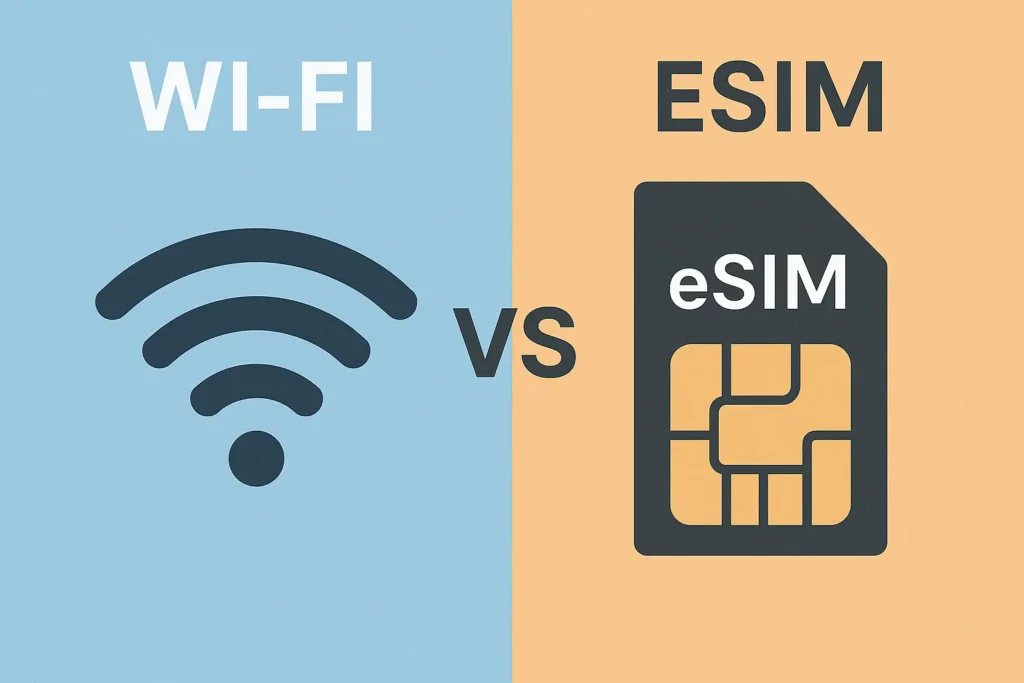
eSIM vs Wi-Fi: Which Is Better for Travel?
An eSIM is better than Wi-Fi for most travelers because it provides secure, always-on cellular data wherever there is network coverage. Public Wi-Fi is free but unreliable, limited to fixed locations, and carries security risks. The best strategy is to use an eSIM as your primary connection and Wi-Fi as a supplement for heavy data usage in trusted locations.
| Feature | eSIM | Public Wi-Fi |
|---|---|---|
| Availability | Anywhere with cellular coverage | Hotels, cafes, airports only |
| Security | Encrypted cellular connection | Often unsecured, vulnerable to attacks |
| Cost | $5–$50 per plan | Usually free |
| Speed & Reliability | Consistent 4G/5G speeds | Varies widely, often congested |
| Mobility | Works on the go | Tethered to hotspot location |
| Setup | Scan QR code, activate in minutes | Find network, enter password, accept terms |
| Best For | Navigation, maps, ride-sharing, messaging | Streaming, large downloads in fixed locations |
What Is an eSIM and How Does It Work for Travel?
An eSIM (embedded SIM) is a digital SIM built into your device that lets you activate a cellular data plan without a physical SIM card. You can purchase and activate a data plan for your destination before you leave home, giving you instant connectivity the moment you land.
Unlike physical SIM cards, an eSIM doesn’t require swapping cards or visiting local stores. Most eSIM-compatible devices also support dual SIM, so you can keep your home number active on your physical SIM while using the eSIM for affordable local data.
Key Benefits of eSIM for Travelers
- Instant activation: Purchase and activate plans digitally within minutes, from anywhere with an internet connection.
- Lower costs: eSIM plans are typically much cheaper than international roaming charges from your home carrier.
- Dual SIM functionality: Keep your primary number for calls and texts while using the eSIM for data.
- Carrier flexibility: Switch between providers and plans without being locked to a single carrier.
- Secure connection: Cellular networks use encryption, making eSIM significantly safer than public Wi-Fi.
When Should You Use Wi-Fi Instead of eSIM?
Wi-Fi still has a place in your travel connectivity strategy. Free Wi-Fi in hotels, cafes, airports, and public spaces can save your eSIM data for when you actually need mobile connectivity.
Wi-Fi Works Best When:
- You’re on a secure, private network: Your hotel’s password-protected Wi-Fi (with a VPN) or a trusted friend’s network.
- You’re staying in one place: Hotel rooms, airport lounges, or coworking spaces where you don’t need to move around.
- You need heavy data usage: Streaming video, large downloads, or video calls that would drain a limited eSIM plan.
- You’re on a tight budget: Free Wi-Fi works for light browsing and messaging when security isn’t critical.
Risks of Relying on Public Wi-Fi
- Security vulnerabilities: Public Wi-Fi is often unsecured, exposing your data to interception. Always use a VPN on public networks.
- Unreliable speeds: Congested hotel or cafe networks frequently deliver slow, frustrating connections.
- Limited coverage: Wi-Fi is unavailable in most outdoor areas, during transit, and in remote locations.
- Signal interference: Crowded public hotspots suffer from radio interference, causing dropped connections and slow speeds.
When to Use eSIM vs Wi-Fi: Quick Guide
| Situation | Best Option | Why |
|---|---|---|
| Walking around a new city | eSIM | Need maps, translation, ride-sharing on the go |
| Relaxing at hotel | Wi-Fi | Save eSIM data, use secure hotel network |
| Online banking | eSIM | Cellular is more secure than public Wi-Fi |
| Video calls / streaming | Wi-Fi | Conserve eSIM data on high-bandwidth tasks |
| Remote areas / transit | eSIM | No Wi-Fi available, cellular coverage only |
| Airport layover | Wi-Fi | Free airport Wi-Fi available, stationary |
How to Choose the Right eSIM Provider
With many eSIM providers available, here’s what to look for:
- Coverage: Verify the provider covers your destination countries. Check coverage maps and traveler reviews.
- Data & validity: Match the data allowance and plan duration to your trip length and usage habits.
- Pricing: Compare prices across providers for similar data and duration. Watch for hidden fees.
- Top-up options: Choose a provider that lets you easily add more data if you run out mid-trip.
- Customer support: Look for 24/7 support — essential when you’re in a different time zone with connectivity issues.
- Device compatibility: Confirm your phone supports eSIM before purchasing a plan.
Frequently Asked Questions
Is eSIM safer than public Wi-Fi?
Yes, an eSIM is significantly safer than public Wi-Fi. eSIMs connect through encrypted cellular networks, while public Wi-Fi is often unsecured and vulnerable to data interception, man-in-the-middle attacks, and fake hotspots. If you must use public Wi-Fi, always connect through a VPN.
Can I use both eSIM and Wi-Fi at the same time?
Yes, your phone automatically switches between eSIM cellular data and Wi-Fi depending on availability and signal strength. When connected to Wi-Fi, your phone uses that connection to save cellular data. When you leave the Wi-Fi range, it seamlessly switches back to your eSIM data plan.
Do I still need Wi-Fi if I have an eSIM?
Not necessarily, but Wi-Fi helps conserve your eSIM data. If your eSIM plan has limited data, using hotel or cafe Wi-Fi for heavy tasks like video streaming and large downloads will make your data allowance last longer throughout your trip.
Does eSIM work without Wi-Fi?
Yes. You need Wi-Fi or an existing data connection only for the initial eSIM activation (scanning the QR code). Once activated, the eSIM connects to local cellular networks independently and does not require Wi-Fi to function.
Conclusion
For reliable, secure internet access while traveling, an eSIM is the better primary option. Use Wi-Fi as a supplement — for heavy data tasks on trusted networks or to stretch your data plan further. By combining eSIM with strategic Wi-Fi usage, you get the best of both worlds: constant mobile connectivity and cost savings.
Explore more: What Is an eSIM?, eSIM Albania, eSIM Turkey, eSIM Egypt, Esimy, Global eSIM, eSIM Europe
eSIM Plans for Destinations in This Article




Travel smarter with eSimy
Instant eSIM plans for 165+ countries. Activate in seconds, connect before you land.
Get Your eSIM Now


